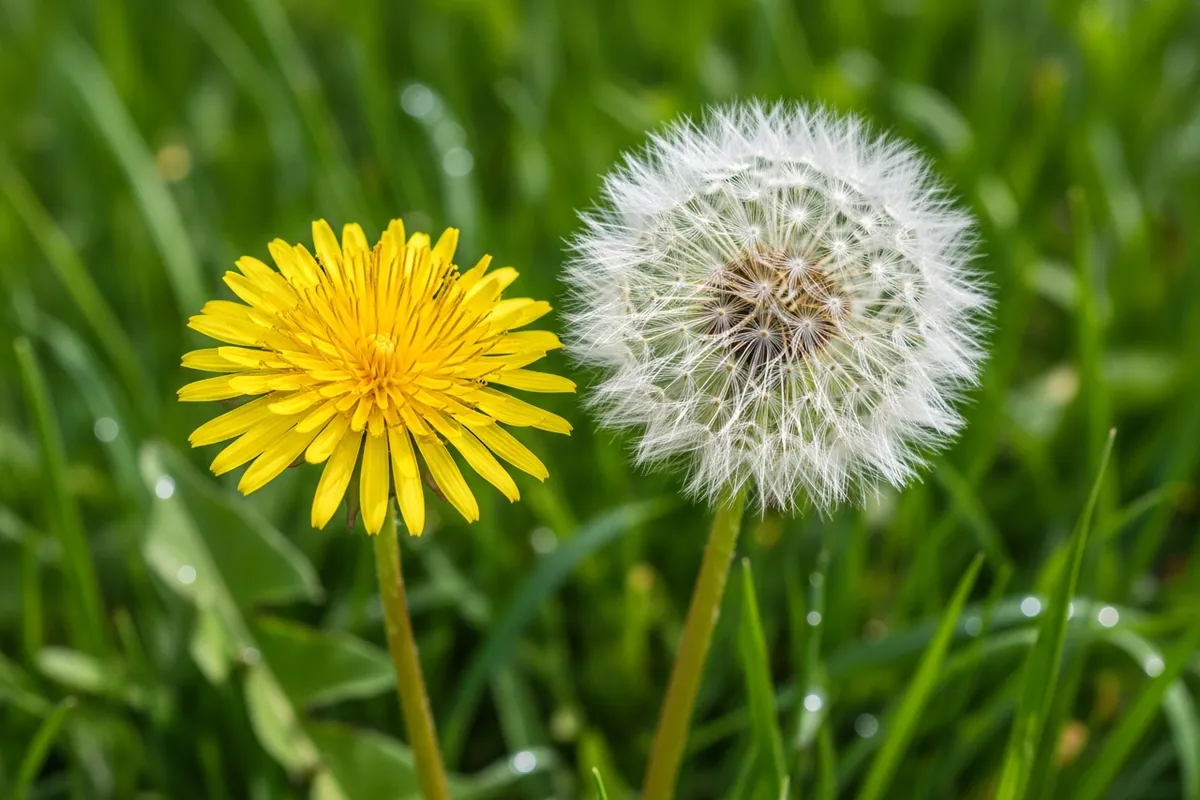
Dandelions are the bright yellow flowers – and white puffball seed heads – that pop up across Utah lawns every spring. They’re harmless to people and pets, but their deep taproot makes them stubborn to remove and their windborne seeds spread infestations across entire neighborhoods. Timed broadleaf herbicide treatments combined with a healthy lawn keep them in check, which is exactly what professional weed control is built around.
Identification
Dandelions (Taraxacum officinale) are unmistakable once they flower: a single bright yellow bloom on a hollow, leafless stalk, followed by a round, white puffball of seeds. The leaves form a low rosette flat against the ground, with deeply toothed, jagged edges – the shape that gave the plant its name, from the French “dent de lion” or lion’s tooth. The taproot can grow more than a foot deep in established plants, which is why pulling rarely works. Dandelions are sometimes confused with cat’s ear, sow thistle, or hawkweed, all of which produce yellow flowers, but those have hairy or branched stems and lack the dandelion’s hollow, single-flower stalk and milky sap that oozes from a broken stem.
Where Dandelions Live in Utah
Dandelions grow throughout Northern and Central Utah, with the heaviest pressure in irrigated lawns, parks, and along roadsides. They tolerate a wide range of soil types and handle Utah’s freeze-thaw winters without issue, which is why they show up reliably year after year. Lawns along the Wasatch Front see strong spring and fall flushes, with a brief slowdown during the hottest part of summer. They establish quickly in thin or stressed turf, sidewalk cracks, garden beds, and any disturbed soil. Once a dandelion goes to seed, the wind can carry those puffballs a remarkable distance, which is why even a well-maintained lawn often gets reinfested from neighboring yards.
Why They Invade Lawns
Dandelions are pioneer plants – they’re built to colonize. The taproot reaches deep moisture and nutrients that shallow-rooted lawn grass can’t access, giving them a competitive edge in compacted, dry, or low-fertility soil. A single mature dandelion can produce well over a hundred seeds per flower head, and those seeds are equipped with a parachute that lets them ride wind currents for blocks. Thin patches in a lawn, bare spots after winter dieback, and edges along sidewalks and driveways give seeds the bare soil and sunlight they need to germinate. The taproot also lets the plant survive mowing, drought, and even partial pulling – a fragment as small as an inch can regrow into a full plant.
Signs You Have a Dandelion Problem
Dandelions are about as easy to spot as weeds get:
- Bright yellow flowers scattered across the lawn in spring and fall
- White, round puffball seed heads forming a few days after flowering
- Flat rosettes of jagged-edged leaves crowding out lawn grass
- Seedlings appearing in garden beds, sidewalk cracks, and gravel
- Bare spots left behind after attempted hand-pulling, where roots regrow
- Increasing populations year after year if seed heads aren’t intercepted
- Heavier infestations along edges, fence lines, and thin lawn areas
What’s the Damage?
Dandelions don’t pose any real health risk – the plant is actually edible, and bees rely on early-spring blooms as one of the first nectar sources of the year. The damage they do is to lawn quality and curb appeal: they crowd out turf grass, leave bare patches when removed, and reseed neighboring areas relentlessly. A heavy infestation can transform a uniform lawn into a patchy, weedy yard within a couple of seasons. The deep taproot also draws moisture and nutrients away from surrounding grass, weakening the turf and creating more openings for additional weeds to move in.
How to Prevent Dandelions Around Your Home
Effective control combines herbicide timing with lawn health:
- Treat with a selective broadleaf herbicide containing 2,4-D in spring or fall when dandelions are actively growing
- Avoid herbicide applications during peak summer heat, when dandelions are dormant and absorption drops
- If hand-pulling, remove the entire taproot – even an inch of remaining root can regenerate a full plant
- Use a long, narrow weeding tool or step-on weed puller for the best chance of getting the whole root
- Apply pre-emergent herbicide in early spring to suppress new seedlings before they emerge
- Maintain a dense, healthy lawn through proper fertilization, deep watering, and overseeding thin areas
- Mow at 3 inches or higher so turf shades out germinating dandelion seeds
- Catch and remove flowers before they go to seed if you only have a few plants
When to Call a Professional
If dandelions are reseeding faster than you can pull them, or if your lawn has reached the point where dozens of yellow flowers appear after every mow, a professional program is the path forward. Green Defense times broadleaf treatments to active growth windows, uses targeted herbicides that protect surrounding turf, and pairs treatment with lawn-health recommendations so your grass starts crowding the weeds out on its own. Request a free quote and we’ll build a season-long plan.