
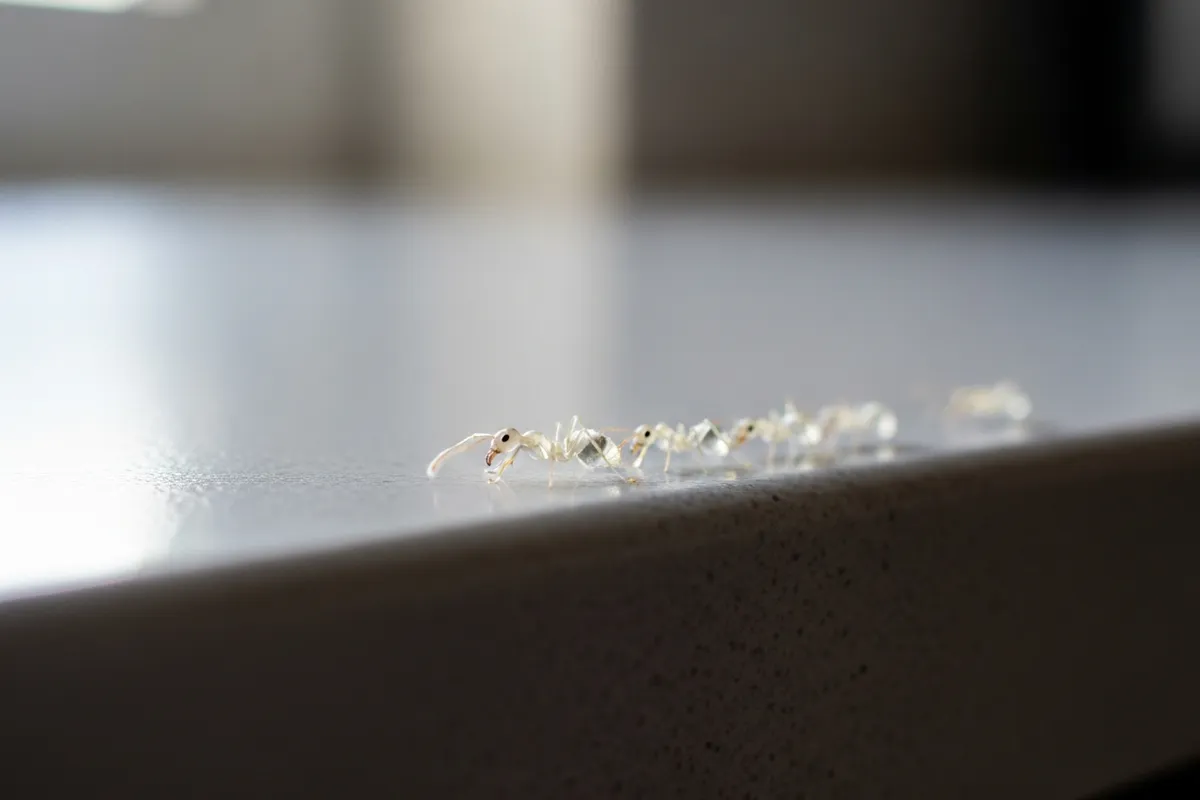
Ghost ants are tiny tropical invaders that have become one of the most common indoor ants in central Florida homes. They’re so small and pale that you often don’t notice them until a trail forms across the kitchen counter. Spraying them on contact only makes the problem worse because their colonies split when threatened. Bait-based control is the only approach that actually works.
Identification
Ghost ants (Tapinoma melanocephalum) are extremely small, only about one-sixteenth of an inch long, which is about the size of the period at the end of this sentence. Their most striking feature is their two-toned body: the head and thorax are dark brown to black, while the abdomen and legs are pale, almost translucent. From a distance they look like dark heads floating across a surface, which is how they got the name “ghost.” They move quickly and erratically, often in faint trails that are easy to miss. Ghost ants are sometimes confused with pharaoh ants, which are similarly tiny, but pharaoh ants are uniformly yellow-orange with a darker abdomen tip. If you crush a ghost ant, it gives off a faint coconut-like odor, which is another reliable identifier.
Where Ghost Ants Live in Central Florida
Ghost ants are native to the tropics and have made themselves comfortable across central and southern Florida, where they’re active year-round. Outdoors they nest under mulch, leaf litter, potted plants, palm fronds, and inside decaying wood. Indoors they nest in wall voids, behind baseboards, inside cabinet voids, around plumbing penetrations, and in potted houseplants. Florida’s warmth and humidity let them shift between outdoor and indoor sites depending on weather. Heavy rain often pushes them inside, and dry spells send foragers searching for moisture in kitchens and bathrooms. They’re a strictly indoor concern in cooler climates and do not establish in Utah.
Seeing Ghost Ants? We can help.
A licensed technician will inspect, treat the problem areas, and come back free if they return between visits.
Why They Get Into Homes
Ghost ants are after two things: sweets and water. They’re especially drawn to sugar, honey, syrup, fruit juice, and any sticky residue on counters or floors. They’ll also feed on greasy foods and protein, but sugar is the strongest draw. Moisture matters just as much as food, so leaky pipes, condensation under sinks, damp sponges, and standing water in plant saucers all attract foragers. Once a scout finds a food source, it lays a chemical trail that recruits the rest of the colony, and within hours you can have a steady line of ants moving across your counter or up the wall.
Signs You Have a Ghost Ant Problem
Ghost ants leave subtle signs because of their size, but they’re consistent:
- Faint trails of tiny ants moving along countertops, baseboards, or window sills
- Ants clustered around sticky spots, sugar bowls, fruit bowls, or pet food dishes
- Small dark dots that seem to disappear when you look closely (the dark heads on pale bodies)
- Activity around bathroom sinks, dishwashers, and other moist areas
- Ants emerging from wall outlets, baseboards, or cabinet hinges
- Trails inside potted plants or along plant stems
- Increased indoor activity after rain or hot, dry weather
What’s the Damage?
Ghost ants don’t bite, sting, or carry serious diseases, and they don’t damage structures. The real problem is contamination and persistence. They walk through whatever they find, including bathroom surfaces and pet bowls, and then walk across food prep areas. They can mechanically transfer bacteria, and their sheer numbers in the kitchen are enough to make most homeowners uncomfortable. Once a colony is established in a wall void, it can produce foraging trails for months or years if it isn’t addressed properly.
How to Prevent Ghost Ants Around Your Home
Prevention is mostly about denying them food, water, and easy entry:
- Wipe counters, stovetops, and sinks daily to remove sugar and food residue
- Store sugar, honey, syrup, and pet food in tightly sealed containers
- Fix dripping faucets, leaky traps, and condensation under sinks
- Empty plant saucers and avoid overwatering houseplants
- Seal cracks around plumbing penetrations, baseboards, and electrical outlets
- Trim landscaping back from exterior walls
- Move mulch and leaf litter away from the foundation
- Take out the kitchen trash regularly and keep it sealed
When to Call a Professional
Ghost ants are one of the few pests where DIY almost always backfires. Spraying contact insecticide kills the foragers you see but causes the colony to split into multiple smaller colonies, a process called budding, which makes the problem worse. Effective control uses slow-acting baits that workers carry back to feed the queens. Professional techs know which baits to rotate, where to place them, and how to address the moisture and entry issues that brought the ants in. Request a free quote and we’ll set up a bait program that actually clears the colony. Learn more about our pest control services.
