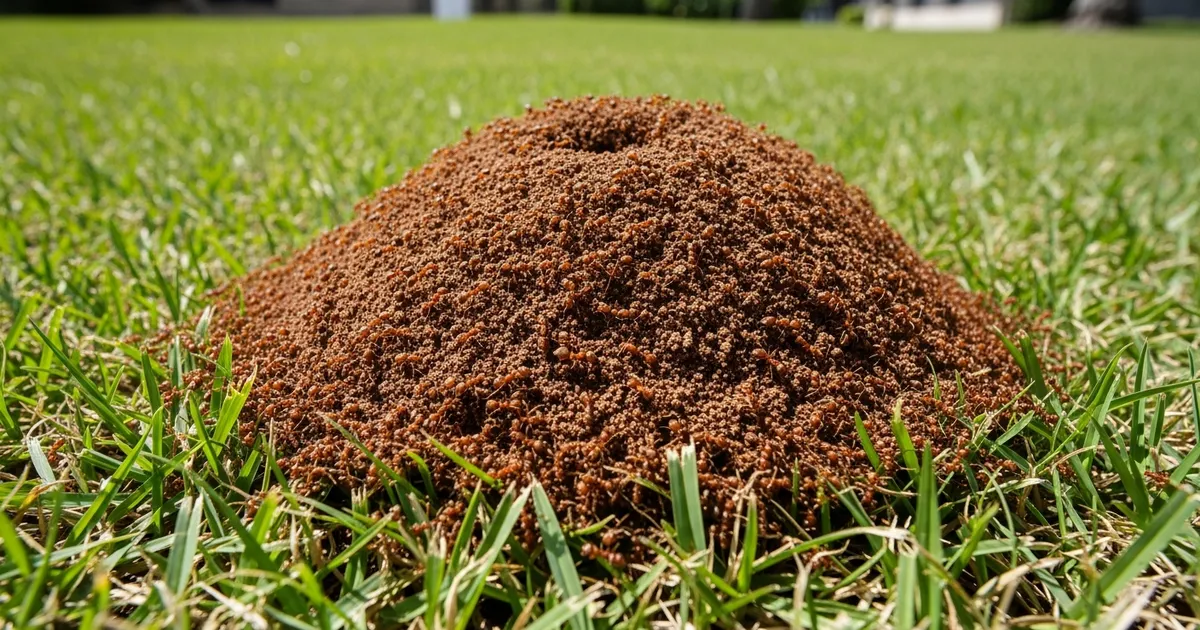
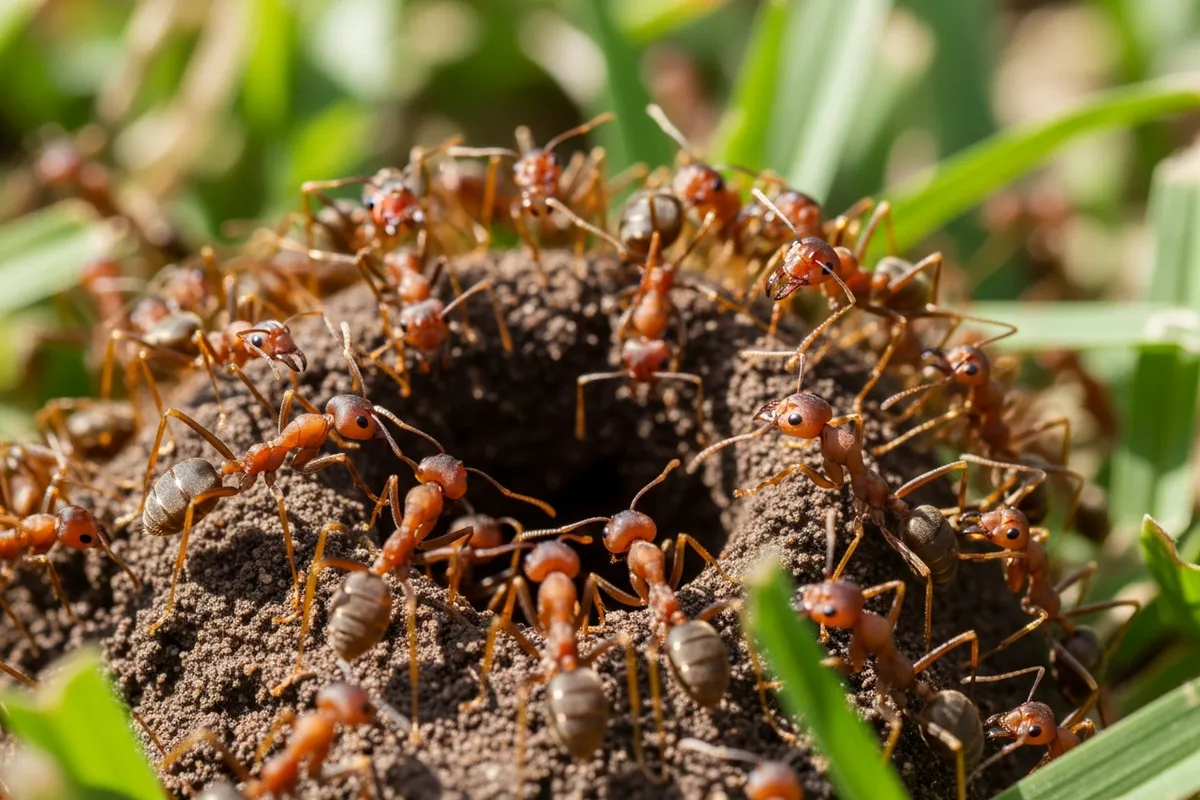
Red imported fire ants (Solenopsis invicta) are an aggressive, sting-first invasive species that have spread throughout Florida since first arriving in the U.S. in the late 1930s. For Central Florida homeowners in Orange, Volusia, and Flagler counties, they show up as dome-shaped dirt mounds in sunny lawns, deliver painful stings that blister into pustules, and can trigger severe allergic reactions in sensitized people. Call a pro the moment you see mounds — DIY drenches almost always make the colony split and spread.
Identification
Fire ant workers are reddish-brown with a slightly darker abdomen and measure roughly 2.4 to 6 mm (about 1/8 to 1/4 inch) long. Workers are polymorphic, meaning a single colony contains a range of sizes rather than one uniform body length. The single most reliable visual clue is the mound itself: a loose, dome-shaped pile of fluffy soil with no central entry hole. Native ants like pavement ants and harvester ants almost always show a clear center opening; fire ants enter through underground tunnels around the base. Mounds pop up in disturbed, sunny soil — open lawns, the edges of sidewalks and driveways, mulch beds, and even inside electrical boxes and AC units, where workers are attracted to the electrical activity.
Where Fire Ants Live in Central Florida
Central Florida’s warm, moist subtropical climate is just about perfect fire ant habitat. They thrive in open, sunny areas — residential lawns, parks, school fields, golf courses, roadside ditches, pastures, and agricultural fields throughout Orlando, Winter Park, Orange City, the Daytona Beach mainland, and Palm Coast. Fire ants entered the U.S. through the Gulf Coast in the 1930s–40s and are now established throughout Florida. You’ll notice mound activity spike after summer rains: water collapses underground tunnels and chambers, so colonies push soil to the surface to repair the damage and rebuild the nest.
Why They’re So Hard to Get Rid Of
Three things make fire ants uniquely stubborn. First, the colony size — a mature mound can hold 80,000 to 240,000 workers, and many Florida colonies are polygyne, meaning they contain multiple egg-laying queens instead of one. Second, budding: when a polygyne colony is disturbed by a spray or a shovel, queens and workers simply split off and start new mounds nearby, so DIY attacks frequently turn one mound into five. Third, reinvasion — neighboring colonies steadily move into any cleared territory. That’s why UF/IFAS recommends the “two-step method”: broadcast a slow-acting bait so workers carry it back to the queens, then treat individual nuisance mounds a few days later. Done correctly, this approach delivers about 90% control.
Signs of a Fire Ant Problem
Fire ants are easier to spot than most lawn pests once you know what to look for. Watch for any of these:
- Loose, dome-shaped dirt mounds in sunny lawn areas, especially fresh ones after a heavy rain
- Reddish-brown ants boiling out aggressively when soil is even lightly disturbed
- Small, painful stings on ankles or hands while gardening, mowing, or playing in the grass
- Mounds clustered along sidewalks, driveways, fence lines, or in mulch beds
- Ants nesting inside AC condenser units, irrigation boxes, or electrical junction boxes
- Livestock, pets, or wildlife showing repeated stings on rural or acreage properties
- White pustules forming on the skin about 24 hours after a sting
If anyone in your household experiences difficulty breathing, throat swelling, hives, or dizziness after a sting, call 911 immediately — fire ant venom can trigger life-threatening anaphylaxis.
Health Risks: Honest Assessment
Fire ants sting rather than bite — they grip skin with their mandibles and then drive a stinger into the bite point, often pivoting to deliver several stings in a circle. The venom is roughly 95% alkaloid (the compound responsible for the immediate burning pain) and about 5% protein (the fraction that drives allergic reactions). Within about 24 hours, each sting site forms a sterile white pustule that can scar if scratched or broken open. Roughly 2% of stung people experience a serious systemic allergic reaction, and a smaller subset develop life-threatening anaphylaxis. Children, the elderly, and anyone with a known insect-sting allergy are at highest risk, and dogs that disturb a mound can be severely affected as well.
How to Reduce Fire Ant Risk Around Your Home
You can’t fire-ant-proof a Florida yard, but you can significantly cut your risk:
- Walk the lawn before letting kids or pets play, and flag known mounds so no one steps on them
- Mow before treating — never disturb mounds first, or you’ll trigger budding
- Keep grass at the recommended cutting height; fire ants love overgrown sunny patches
- Eliminate standing water and fix irrigation leaks; moisture concentrates colonies
- Seal trash bins and clean up pet food, sugary spills, and fallen fruit
- Inspect AC condensers, irrigation boxes, and outdoor outlets for soil intrusion
- Treat year-round — Florida winters are too mild to give you a natural break
- Skip gasoline, boiling water, and bleach — these are dangerous, environmentally damaging, and usually just relocate the colony rather than kill it
When to Call a Professional
If you can see mounds, you have a colony — fire ants don’t move out on their own, and DIY mound drenches almost always trigger budding. Bring in a pro any time you have visible mounds, anyone in the household with an insect-sting allergy, kids or pets using the yard, a large property where mound-by-mound treatment isn’t realistic, or a recurring infestation after self-treatment. Green Defense uses the UF/IFAS-recommended two-step approach across our Central Florida service area: a broadcast bait knocks down the colony from the inside, followed by targeted mound treatment of any stragglers. Because reinvasion is constant in Florida, ongoing quarterly maintenance is the realistic standard. Request a fire ant quote and we’ll inspect your yard at no cost.